

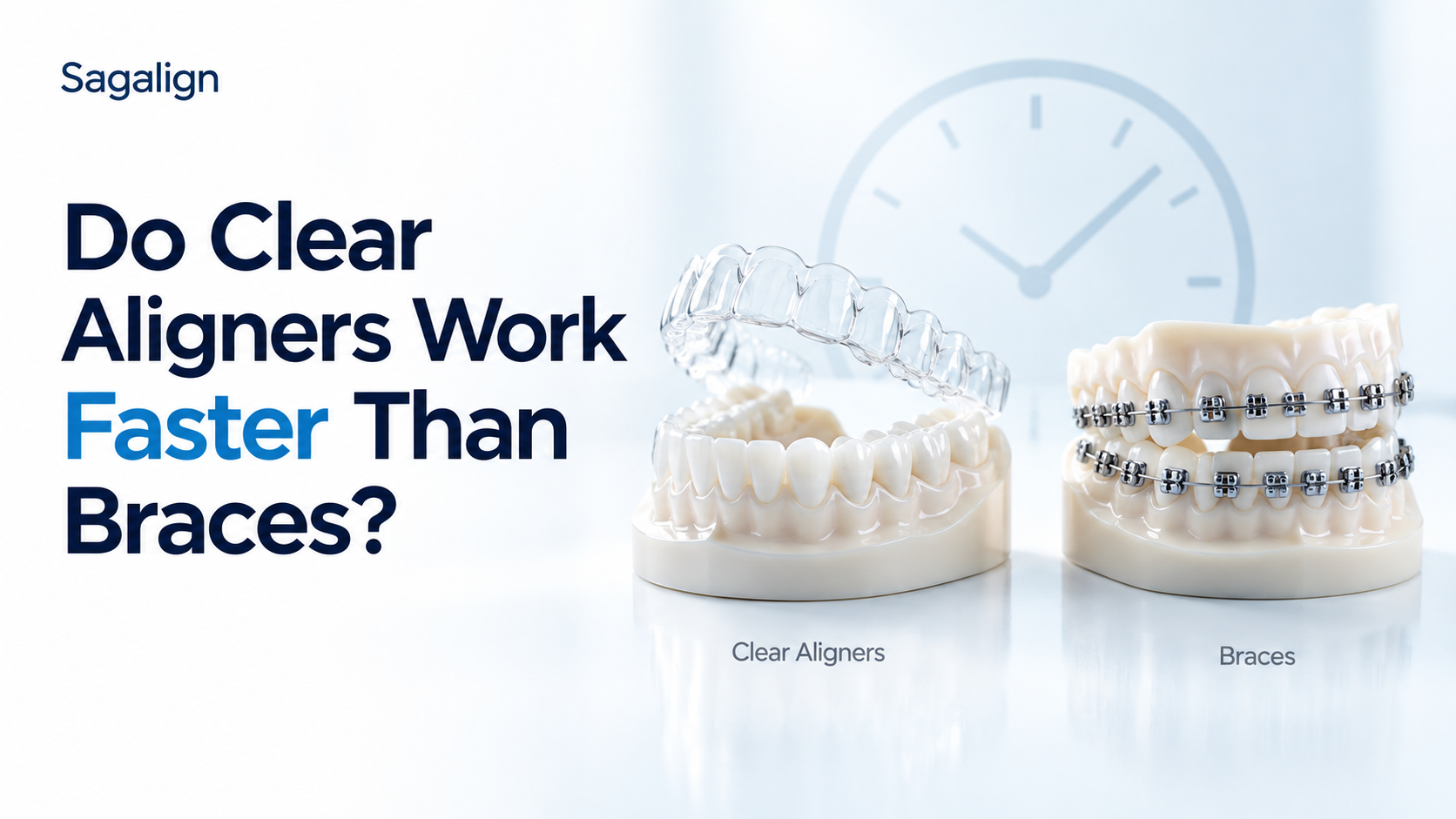
Do Clear Aligners Work Faster Than Braces? An Honest Comparison
Speed is one of the most common questions people have when comparing clear aligners and traditional braces. The truth is: for many patients, clear aligners do work faster. But the full answer depends on the case type, the system used, and, critically, how consistently the patient wears the aligners. In this article, we break down the real treatment timelines for both options and help you understand what to expect for your specific situation.
Do Clear Aligners Work Faster Than Braces?
For mild to moderate cases involving crowding, spacing, and minor bite correction, clear aligners such as Sagalign Clear Aligners may work faster than traditional braces in some cases, but neither option is consistently faster. Treatment time depends on the specific case and the movements required. For complex cases involving severe bite issues or significant jaw misalignment, braces may be more appropriate, sometimes alongside additional treatment. One of the main factors affecting progress with clear aligners is patient compliance: patients should generally wear aligners 20 to 22 hours per day, as prescribed by the treating dentist.
In This Article
• How long do clear aligners take compared to braces?
• What affects how fast clear aligners work?
• Clear aligners vs braces treatment time, by case type
• Why clear aligners are faster for mild and moderate cases
• When braces may still be the faster option
• How to get the fastest results from clear aligners
• Clear aligners vs braces, full comparison
• FAQ
How Long Do Clear Aligners Take Compared to Braces?
Clear Aligner Treatment Time
Average clear aligner treatment for mild to moderate cases: 6 to 12 months. Simple cases, mild crowding or small gaps, can finish in 3 to 6 months. More complex cases with bite correction typically take 12 to 18 months. With digitally planned systems like Sagalign clear aligners, the full timeline is mapped out before the first tray is placed.
Traditional Braces Treatment Time
Traditional braces typically require 18 months to 3 years. Simple cases may finish closer to 12 months, but moderate and complex cases routinely extend to 2 years or beyond. Braces are adjusted reactively; the dentist responds to how teeth are moving at each visit, which adds time compared to a pre-planned aligner sequence.
The Key Difference
Clear aligners plan the entire tooth movement journey digitally before treatment begins. Braces work progressively, adjusting at each appointment. For cases within the capability of clear aligners, this pre-planned approach is inherently more efficient.
What Affects How Fast Clear Aligners Work?
Wear Time: The Most Important Factor
Clear aligners only move teeth when they are in the mouth. The recommended minimum is 20 to 22 hours per day. Patients wearing aligners for fewer hours slow down tooth movement significantly; over weeks, this adds up to a noticeably extended timeline and may require additional aligner sets.
Case Complexity
The more movement required, the longer treatment takes. Clear aligners are most efficient for mild to moderate cases, their speed advantage over braces is greatest in this range.
Switching Trays and Attending Check-Ins
Each tray is designed for a specific period, typically 7 to 14 days. Delaying tray changes, even briefly, delays the overall timeline. Regular check-ins allow the dentist to catch tracking issues early, before they extend treatment.
How Clear Aligners Can Support Efficient Treatment
· Treatment is digitally planned before the first tray, providing a clear sequence of intended tooth movements.
· Each aligner is designed to apply controlled force to selected teeth at each stage.
· Patients change trays at home according to their dentist’s prescribed schedule.
· Some treatment plans require fewer clinic visits, although regular monitoring remains essential.
· If further correction is needed, additional aligners called refinements can be planned. These may extend the overall treatment time.
When Braces May Still Be the Faster Option
• Severe skeletal discrepancies where jaw position needs significant correction
• Cases requiring significant vertical tooth movement, which aligners handle less efficiently
• Patients unlikely to maintain consistent aligner wear; braces are fixed and require no compliance
• Complex multi-tooth movements beyond the current limits of digital planning
Choosing clear aligners over braces for these cases hoping for faster treatment can backfire; additional refinement rounds may result in a longer overall timeline than braces would have required.
Step by Step: Keeping Your Clear Aligner Treatment on Track
Step 1: Build a Daily Wear Routine
Follow your dentist’s recommended wear time and make wearing your aligners a consistent part of your day.
Step 2: Change Trays as Directed
Follow your prescribed schedule rather than rushing ahead to finish sooner.
Step 3: Attend Your Check-Ins
Use these visits to review your progress and discuss any questions with your dentist.
Step 4: Report Any Problems
If a tray does not fit properly or an attachment comes off, contact your dentist for guidance.
Clear Aligners vs Braces, Full Treatment Comparison
|
Clear Aligners (e.g. Sagalign) |
Traditional Braces |
||||||
|
General Duration |
|
|
||||||
|
|
|
||||||
|
|
|
||||||
|
Which is Faster? |
|
No automatic speed advantage |
Frequently Asked Questions
How long do clear aligners take to straighten teeth?
Mild cases: 3 to 6 months. Moderate cases: 6 to 12 months. Complex cases: up to 18 to 24 months. The exact timeline depends on case complexity and how consistently the aligners are worn.
Are clear aligners faster than braces for crowded teeth?
Clear aligners may be faster in some cases of mild to moderate crowding, but this is not guaranteed. Treatment time depends on the tooth movements required and how consistently the aligners are worn. For severe crowding, braces may be more appropriate for certain movements.
What happens if I do not wear my aligners for 22 hours a day?
Teeth spend time drifting back rather than moving forward. Over weeks this extends the timeline, may require additional aligner sets, and can result in an outcome that does not fully match the original simulation.
Can clear aligners fix an overbite faster than braces?
Clear aligners can treat some mild to moderate overbites, but they are not necessarily faster than braces. For deep or severe overbites, braces with additional appliances may offer better control in certain cases. The best option depends on the cause and severity of the overbite, which your dentist or orthodontist can assess at a consultation.
How long does Sagalign treatment take?
Sagalign clear aligner treatment typically takes 6 to 12 months for mild to moderate cases, and as little as 3 to 6 months for simple cases. The full timeline is mapped out in the digital treatment simulation at your first consultation, before any aligner is made.
Do clear aligners work faster if I switch trays more often?
Not without your dentist's guidance. Switching too early means the teeth have not completed the movement that tray was designed for, which causes tracking issues and can extend treatment. Always follow your dentist's prescribed schedule.
About Sagalign Clear Aligners
Sagalign is a clear aligner system developed Iraq and produced by 3D Masters. Its digital workflow supports treatment planning and the production of custom aligners, helping patients understand the proposed stages of their smile journey.
Your Sagalign dentist assesses your teeth and bite, explains the estimated treatment duration, and monitors your progress. The timeline depends on your individual case and how consistently you follow the prescribed wear schedule.
Want to Know How Long Your Treatment Would Take?
The only way to get an accurate timeline is a consultation with a Sagalign-certified dentist. A digital scan takes minutes, the simulation is immediate, and you will leave knowing exactly how long treatment is expected to take, before committing to anything. Contact Sagalign Team to find a certified dentist near you.