

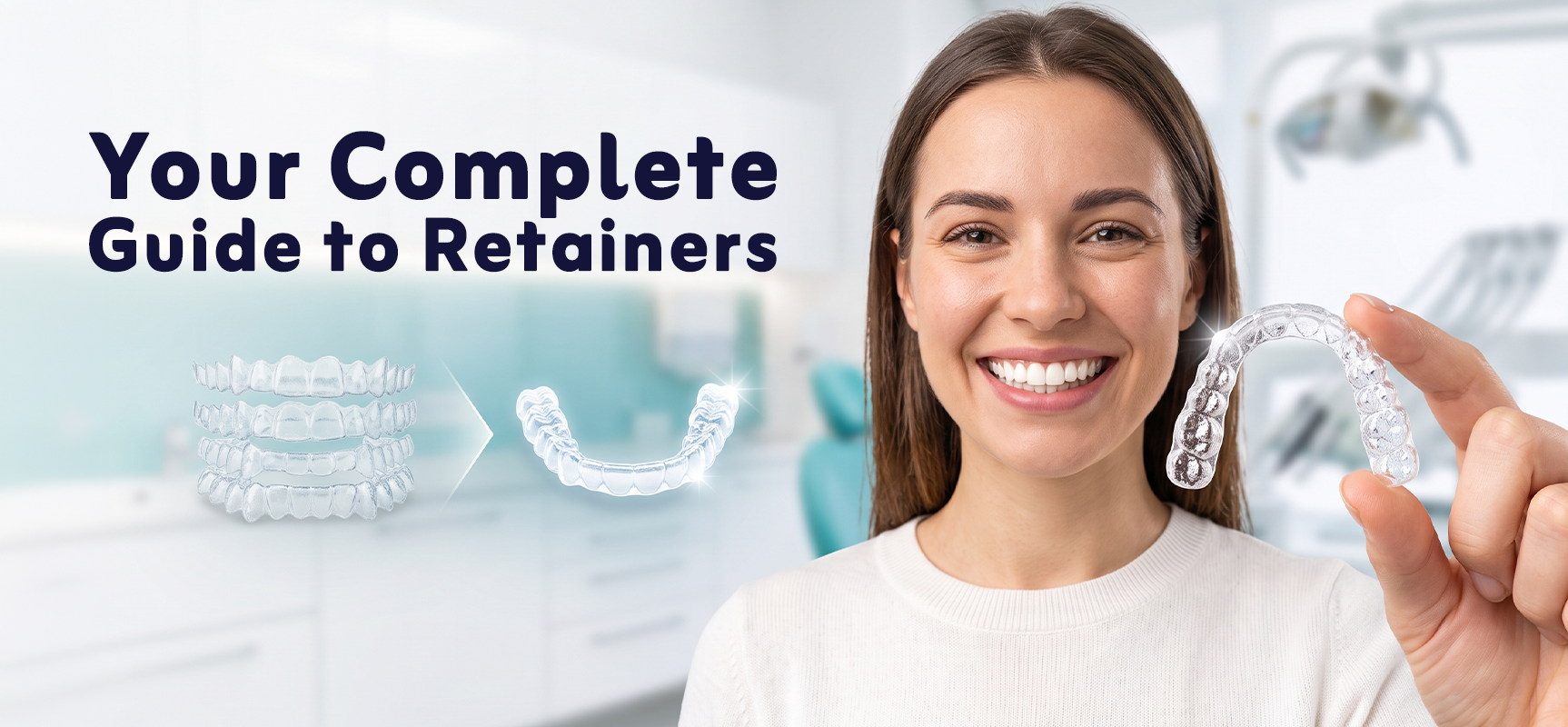
What Happens After Clear Aligner Treatment? Your Complete Guide to Retainers
Completing clear aligner treatment is an exciting milestone. However, treatment does not truly end when you remove your final aligner. The next stage, which is retention, is essential for protecting your newly aligned smile.
After orthodontic treatment, teeth naturally tend to move over time. A retainer helps keep them in their corrected positions while the surrounding bone and tissues adapt. In this guide, we explain why retainers are necessary, the types available, how long they should be worn, and how to care for them properly after Sagalign clear aligner treatment.
Why Do You Need a Retainer After Clear Aligner Treatment?
After clear aligner treatment, including treatment with Sagalign clear aligners, the teeth have reached their planned positions. However, the surrounding bone, gums, and periodontal ligaments still need time to adjust. Without consistent retainer wear, some degree of tooth movement is highly likely over time. Retention is necessary after all forms of orthodontic treatment; it is not a limitation of clear aligners but a normal part of maintaining orthodontic results.
In This Article
• Why teeth move after orthodontic treatment
• Types of retainers available
• How long retainers should be worn
• How retainers are made after Sagalign treatment
• How to care for a retainer
• What happens if you stop wearing it
• Removable and fixed retainers compared
• Frequently asked questions
Why Teeth Can Move After Orthodontic Treatment
Teeth are supported by periodontal ligaments, fibres that connect each tooth root to the surrounding bone. When aligners move a tooth, these fibers and the surrounding bone gradually adapt to the new position. This adaptation does not finish immediately after the final aligner. Bone remodeling and tissue stabilization continue for several months, leaving the teeth more vulnerable to movement during the early retention period. Even after this initial period, teeth can continue to change naturally because of aging, oral habits, and other biological factors, which is why long-term retainer wear is usually recommended.
Types of Retainers Available
The most suitable retainer depends on your original tooth positions, the movements completed during treatment, your oral hygiene, and your ability to follow the recommended wear schedule.
Removable Clear Retainer
A removable clear retainer is a transparent thermoplastic tray designed to fit closely over the teeth. Clear retainers are nearly invisible when worn and can be removed for eating, brushing, and flossing. They are commonly worn full time during the initial retention period before transitioning to nighttime wear. Their effectiveness depends on consistent use.
Fixed or Bonded Retainer
A fixed retainer consists of a thin metal wire bonded behind the front teeth. Because it remains in place continuously, the patient does not need to remember to insert it every night. Fixed retainers require careful cleaning around the wire and must be checked regularly in case the bonding loosens or breaks.
Combination Approach
Some patients benefit from using both types, for example, a fixed retainer behind the lower front teeth together with a removable clear retainer worn at night. This can provide continuous support in areas more vulnerable to movement while maintaining the positions of all teeth.
How Long Do You Need to Wear a Retainer?
Many patients are instructed to wear a removable retainer full time for the first few months, then transition to nighttime wear as the teeth become more stable. The most honest answer about how long retention should continue is: for as long as you want to maintain your results. Teeth can continue changing throughout life, even in people who have never had orthodontic treatment. Always follow the schedule given by your treating dentist rather than adjusting wear time independently.
How Retainers Are Made After Sagalign Treatment
After your dentist confirms that your Sagalign treatment is complete, a retainer is created to match your finished tooth positions. Depending on your result and your dentist's assessment, the laboratory may use your existing digital treatment records, or your dentist may take a new intraoral scan to record the teeth exactly as they appear after treatment. The retainer is then digitally designed and manufactured to fit the final positions.
If your retainer is later lost, damaged, or no longer fits correctly, contact your dentist promptly. The dentist will determine whether a replacement can be produced from available digital records or whether a new scan is required. Your Sagalign-certified dentist in Iraq can arrange this through Sagalign Team.
Step-by-Step Retainer Placement After Clear Aligner Treatment
Receiving a retainer after clear aligner treatment is a simple process that helps protect your newly aligned smile. Here is what patients can usually expect:
Step 1: Final Treatment Assessment
The dentist examines the teeth and bite to confirm that the planned clear aligner movements have been completed successfully.
Step 2: Attachment Removal
Any remaining aligner attachments are carefully removed, and the tooth surfaces are polished to create a smooth finish.
Step 3: Digital Scan
An intraoral scan may be taken to record the final tooth positions and create an accurate digital model for the retainer.
Step 4: Retainer Production
The retainer is digitally designed and manufactured to fit securely over the finished tooth positions.
Step 5: Retainer Fitting
Once ready, the dentist checks the retainer’s fit, comfort, and stability. Small adjustments may be made if necessary.
Step 6: Care and Wear Instructions
The patient receives a personalized wear schedule and instructions for cleaning, storing, and replacing the retainer when needed.
How to Care for Your Retainer
Caring for a Removable Clear Retainer
• Rinse with cool or lukewarm water after removing; never use hot water, which distorts the material
• Clean gently with a soft toothbrush and mild liquid soap; avoid abrasive toothpaste
• Store in its protective case whenever not in your mouth
• Keep away from pets and do not wrap in tissue where it may be thrown away
• Contact your dentist if cracks, distortion, or changes in fit appear
Caring for a Fixed Retainer
• Brush carefully around the wire and bonding material every day
• Use a floss threader or interdental brush to clean beneath the wire
• Avoid biting very hard foods directly with the front teeth
• Contact your dentist if the wire feels loose, broken, or distorted
• Do not attempt to repair or remove a fixed retainer yourself
What Happens If You Stop Wearing Your Retainer?
Tooth movement can begin after retainer wear is interrupted, particularly during the first months following treatment. The lower front teeth are especially prone to crowding, although movement can occur anywhere. If your retainer feels slightly tight but still seats completely, contact your dentist for advice.
Do not force a retainer into place if it does not fully seat, causes considerable pain, appears damaged, or if a fixed retainer feels loose. Depending on the amount of movement, your dentist may recommend replacing the retainer or, in cases of more significant relapse, additional aligner treatment.
Removable vs Fixed Retainers: At a Glance
|
Feature |
Removable Clear Retainer |
Fixed Bonded Retainer |
|
Material |
Clear thermoplastic material |
Metal wire bonded behind the teeth |
|
Visibility |
Nearly invisible when worn |
Not visible from the front |
|
Removability |
Removed by the patient |
Removed only by a dentist |
|
Cleaning |
Removed and cleaned separately |
Requires cleaning around and beneath the wire |
|
Wear schedule |
Full-time initially, then nighttime as directed |
Remains in place continuously |
|
Patient cooperation |
Must be worn consistently |
Does not depend on remembering nightly wear |
|
Repair or replacement |
Replaced when worn or no longer fitting |
Repaired or rebonded if it becomes loose |
|
Often suitable for |
Many clear aligner patients |
Patients who benefit from continuous retention |
Neither option is automatically better for every patient. Your dentist may recommend one type or a combination based on your treatment and long-term retention needs.
What Consistent Retainer Use Protects
• The tooth alignment achieved during treatment
• Improvements made to your bite
• The time and effort invested in wearing your aligners
• The financial investment made in treatment
• Your confidence in your finished smile
Frequently Asked Questions
How soon will I receive my retainer after finishing treatment?
Your dentist will first confirm that planned tooth movements are complete and the bite is stable. The retainer may be provided the same day or prepared shortly afterward. Your dentist may advise continuing to wear your final aligner temporarily while it is being manufactured.
Can I use my final aligner as a retainer?
Your dentist may suggest wearing the final aligner temporarily while waiting for your retainer. However, it should not replace a purpose-made retainer long term. Aligners can wear and distort with extended use, whereas a retainer is specifically designed to maintain finished tooth positions.
What should I do if my retainer breaks or gets lost?
Contact your dentist as soon as possible. Your Sagalign-certified dentist will determine whether a replacement can be created from existing digital records or whether a new scan is needed. Follow your dentist's instructions rather than using a damaged or poorly fitting retainer.
What if I forget to wear my retainer for several nights?
Wear it again if it still fits fully without significant pain. If it feels unusually tight, does not seat correctly, or causes considerable discomfort, stop and contact your dentist. Do not force it over teeth that have noticeably moved.
Do I still need to visit my dentist after treatment?
Yes. Regular appointments allow your dentist to evaluate the fit and condition of your retainer, check a fixed wire if you have one, and identify early tooth movement before it becomes more difficult to manage. Continue routine examinations and professional cleaning to maintain healthy teeth and gums.
About Sagalign Clear Aligners
Sagalign clear aligners use a fully digital workflow that covers every stage of treatment, from the initial scan and personalized treatment plan to aligner production and post-treatment retention. After completing treatment, your Sagalign-certified dentist will assess your final results and recommend a suitable retainer plan to help maintain your new smile.
Questions About Your Retainer or Post-Treatment Care?
Finishing your final aligner is an important achievement, but maintaining the result requires one lasting habit: wearing your retainer as directed. Contact Sagalign Team in Iraq if you have questions about your post-treatment or if your retainer feels uncomfortable, becomes damaged, no longer fits, or needs to be replaced. Consistent retention and regular dental checks can help keep your new smile stable for years to come.